“You guys have a +64 number, but you don’t sound like Kiwis,” muses the Kiwi who picks us up in Banff for a wildlife tour. This is the first indicator that Banff is basically Queenstown, NZ – everyone working in tourism and hospitality seems to be from somewhere that isn’t elsewhere in Canada (in the same way that nobody working in these industries in Queenstown is actually from NZ).
The main similarity between both places is the heavy tourism footprint. The streets of Banff are filled with backpackers, climbers, and casual sightseers, drawn by the sheer mountain faces and jagged peaks which encircle the town. Much like the Icefields Parkway, it doesn’t matter where you stop in this bustling alpine resort – there are views a-plenty right from the streets of the town centre. And much like the Icefields Parkway, people do stop wherever they like to snap pictures of said mountains – even if that somewhere is the level crossing on Banff Avenue. Traffic be damned, people gotta ‘Gram (apparently).
Which brings us onto an interesting point of difference: unlike Queenstown, traffic ain’t even a thing. Growth management, commercial caps, and environmental preservation are prioritised over unbridled expansion, meaning decisions over land use and visitor management are heavily scrutinised through an ecological lens. Unlike the still-expanding Queenstown urban sprawl, the townsite is legally and physically restricted to a (highly walkable) 4 square kilometre grid. An aggressive transit and park-and-ride structure is in place too; you can park for free on the outskirts of town, and heavily subsidised or free shuttles connect you to where you want to go. There’s something working here for sure. I want to say, ‘Queenstown take note!’ but I think that ship has well and truly sailed.
The town centre vibes are remarkably similar though. People fuel up at bakeries or mooch around the outdoor gear stores by day, and by night, the steakhouses are buzzing with après-adventure conversation. The outdoor heaters fire on patios and the snow-dusted mountains wear rosy crowns as the sun slips away.
Backtrack a Minute: A Wildlife Tour? Wait, what?
Social media has us believing that we’ll be tripping over grizzlies in the National Parks but so far it hasn’t been the case. I’m not desperate to meet a bear (refer previous posts) but by this point I’m thinking it would be nice to see them just doing their bear-y thing from the safety of a vehicle, ideally before encountering one out walking somewhere. (Ultimately, the ideal would be to see them in some scenario that somewhat evidences the point everyone we talk to makes – bears don’t care about people therefore there’s no need to worry about them, unduly).
However, we go on the wildlife tour and we see no bears. Of course, wildlife gonna do what wildlife gonna do so it was never a guarantee. Nonetheless, our Kiwi guide entertains us with stories of ‘The Boss’ – a 300kg grizzly who rules over 2,500 square kilometres of Banff, Yoho, and Kootenay National Parks.
Born around 1997, The Boss is old for a grizzly – especially considering the highways, train tracks, and heavy human presence in his environment – but his survival has been credited to the fact that he’s somewhat the Chuck Norris of bears. His most legendary feat is surviving at least one (possibly two) direct collisions with freight trains, whilst scavenging and foraging along the tracks. Identifiable by his battle scars and missing teeth from decades of fighting other large males (and by the chunk missing from his ear where he tore out the tracking chip Parks Canada put in), this is not the bear you want to meet in the woods: unlike most grizzlies that rely predominantly on berries, roots and smaller mammals, The Boss is known for hunting larger prey. Back in 2013, a hiking trail was closed after he was found to be actively hunting and then consuming an adult black bear – yikes!
However, many people do try to get too close to The Boss, and because of this he’s become habituated to human presence. This is a dangerous, of course – for both the humans and the bear. Though it’s absolutely a last resort, lethal removal is standard protocol for Parks Canada in a high-risk, highly habituated wildlife management scenario. Parks have publicly noted that they would like to help the aging bear live out his ‘retirement years’ safely, but his future depends heavily on whether people give him the required space. One thing’s for sure though: having fathered somewhere between 50-70% of all grizzly cubs in the Banff area, The Boss’s legend will live on long after he’s gone.
Our wildlife tour is still a lot of fun as there are plenty other wild animals out and about. We see big-horned sheep on the road to Mount Norquay. Big-horns seek out ‘mineral licks’ to supplement their plant-based diets, and they often satisfy their salty cravings by licking up dried road salt. Mount Norquay, being a windy, steep road, is prone to icing and so is often salted to keep it safe for vehicles. Additionally, the switchbacks in the road navigate around steep and rocky terrain which the big-horns love – they can easily scramble up over this whereas their predators, like cougars and wolves, can’t.
We catch sight too of a fabulous fox, his ginger tail flashing as he dashes through the blonde grasses, and more bull elk who are rutting on, of all places, the Banff Springs Golf Course. Parks Canada are out in force, firing paint balls at them in an attempt to keep them away from the town. Though elk are plenty dangerous to humans (see previous post) the thinking behind this strategy is, where the prey goes, the predators follow. The golfers are entirely unfazed.
The Iron Path of Mount Norquay
For a little something different, we have a ‘via ferrata’ route on Mount Norquay planned for our time in Banff. Via ferrata (Italian for ‘iron path’) is a protected climbing route equipped with steel cables, rungs, ladders, and bridges fixed to the rock face. It allows hikers and climbers to traverse steep or inaccessible terrain without needing advanced technical rope skills (you’re continuously ‘clipped in’ to the steel cable, via two carabiners on the end of two elasticated ropes). Historically, these routes originated in the Italian Dolomites during World War One to move troops, supplies, and artillery quickly and safely across high-altitude alpine ridges. Today, they’ve evolved into an adventure tourism activity, allowing outdoor enthusiasts to experience dramatic, vertical exposure with the security of a harness and shock-absorbing lanyards.
On the day we’re booked there’s another bluebird sky, though we notice that the temperature has cooled significantly. We meet Dan, our instructor and guide, and another couple who’ll be with us on ‘The Summiteer’, which does exactly what it says on the tin and tops out on the east summit of Mount Norquay. ‘Airy’ three-wire suspension bridges are promised, as well as a lot of traversing.
It’s a physically demanding experience. Dan assures me that the route was tested by a guide who is 3 inches shorter than me, but my limbs are often at the absolute limits of where they will stretch to. It is immense fun! Dan and the other couple are delightful humans, and we laugh our way through the day as we contort our bodies around rocks and haul ourselves up the iron rungs.
Via ferrata, as with climbing, also demands absolute focus. (Allow me this sidebar, friends, for a wee moment of personal reflection). As someone who struggles with racing, overlapping, and sometimes invasive thoughts very often, I realise at the end of the day that part of the reason I absolutely loved this experience was because my brain was completely quiet for the 6 hours we spent out there. There’s no room for other thoughts when you’re fixated on the task of safely navigating rocks – I was completely absorbed in the whole experience. Also very, very weird for me – I realised later that I wasn’t, at any point, scared. I felt comfortable, calm and safe throughout. Again, for someone who generally lives with low-level anxiety continuously humming along in the background, this is interesting. I guess anxiety tends to be future focussed, rather than in the here and now of doing something but irrespective of this, and many weeks later, I’m still reflecting on how positive this experience was for me, and what I can take from it and integrate into my life for my own mental wellbeing.
OK, maybe the three-wire suspension bridges are a little scary, but not insurmountably so. The wind picks up a bit as, one by one, we inch our way across and above an impressive couloir many metres below. There’s a lot of movement in the bridge which again brings much levity to the situation as we laugh at each other wobbling our way across – but there are many calls of encouragement to each other too.
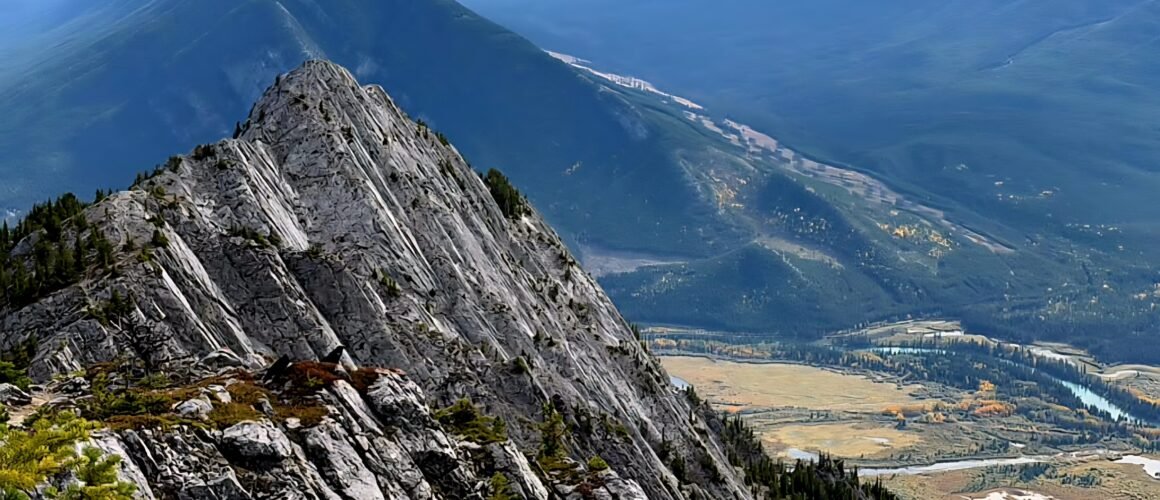
Being on the exposed rock all the way up the mountain, the views are, of course, superb. At the summit we are rewarded with a 360-degree vista of rugged limestone peaks, braided riverways, and alpine valleys. Banff town, nestled in the loop of the Bow River, is sprawled below in miniature beneath the shadow of wedge-shaped Mount Rundle, its iconic and dramatically tilted slabs dominating the horizon to the south. Dan points out the gondola on Sulphur Mountain (another of Banff National Park’s most famous peaks) and the Sundance Range beyond, framing the rim of the Bow Valley. Tiny Tunnel Mountain (‘an after-dinner hike’, says Dan) is visible too as well as the shallow Vermillion Lakes, oft depicted in early paintings by visiting artists due to the way they reflect the sky and surrounding peaks in their waters.
The mountain Dan is most excited to point out is Mount Louis. Though not as tall as some of the 2,900 – 3,000m peaks in the Bow Valley, Mount Louis is striking because of its prominent ‘Diamond Face’ – a massive, near vertical, diamond-shaped slab of rock. It’s where the ‘serious’ rock climbers go. We stop for lunch and everyone takes too many photos of these marvellous views before we head back down.
A Rest Day
We’ve been lucky with the weather. We awake to fine drizzle and overcast mountains, but when the cloud clears, we see snow on the surrounding peaks. We break out the rainwear for the first time for an semi-urban hike into the town centre, starting along the trails at the foot of Tunnel Mountain.
In the forest we meet a runner who tells us she’s had to go off-trail due to a ‘huge’ bull elk on the path. We creep along warily, mentally preparing for a confrontation as we round each bend when eventually we spot him. He has sat down under the trees with his harem, and he doesn’t seem too concerned with us. It takes us a few moments to notice a photographer in camo gear, emerging from the foliage and edging closer to the animal. The bull’s gaze is fixed firmly on the man, and we take the opportunity to grab a few pictures ourselves. We’re too far away for the pictures to be particularly good, but this bull is a big lad and we dare not get any closer.
Our path takes us to ‘Surprise Corner’ and a viewpoint to the Fairmont Banff Springs Hotel. The Canadian Pacific Railway opened the original Banff Spring Hotel in 1888, looking to tourism as a way to recover the enormous costs of building the ribbon of steel that connects the Atlantic to the Pacific. The hotel immediately assumed its role as the main attraction in a chain of luxury railway hotels from coast to coast along the CPR line. Evolving in form over the years and rising from the ashes of a fire in 1926, the current hotel remains a symbol of the visions that brought Canada to nationhood.
We wander along the Bow River to Bow Falls. Elk cows are settled beneath the trees lining the path, unperturbed by the many walkers who stop to photograph them. We take a walk through the Cascade of Time Garden too, the paths winding through brightly coloured flowers and dark ponds reflecting the surrounding vegetation. As we get into the town centre, the weather seems to be turning and it feels like it’s trying to snow so we stop into the Whyte Museum to get out of the cold. However, there’s a private event on so we end up back outside to tour the heritage homes on the museum grounds. The historic log cabins relocated to this site provide a window into the lives of early pioneers who guided, explored, and ultimately lived in and around the Banff area.
It’s the first day in a while we’ve had where the main object of the day is a relaxed wander and we stop off for dinner in one of the gastropubs, named after that iconic bear, The Boss. Tomorrow, we head out of town and onto our next stop in Yoho National Park. We chat about potential hikes as we sip our beers, wondering if the drizzle will come to anything and if we’ll get all the walking in that we’ve planned, before the weather turns.
Next Stop, Yoho National Park