As it turns out, nobody is really all that concerned about bear attacks; it’s the elk you’ve got to watch out for.
“Yeah, the bears tend to ignore you; they’re more focussed on finding food. But the elk will give you a little chase if you get too close. I’m more scared of the elk.”
This from the Australian lad working for Parks Canada who checks us in at Whistler’s Campground, Jasper. As you know, ‘Straya has more than its fair share of deadly creatures, so this is saying something.
Elk: Actually Everywhere
It’s September so we’re right in the middle of elk mating season, or ‘the rut’, where mature males (bulls) compete to control groups of females (cows). Dominant bulls herd up to 20 cows in a ‘harem’, constantly defending them from rival males. To attract cows, bulls scrape their antlers on trees, dig up dirt with their hooves, and wallow in mud soaked with their own urine to coat themselves in pheromones that signal strength and readiness to mate. Cows are attracted by the size of a bull’s antler rack and the strong scent from the wallow, both signalling that the male is of prime age and vigour.
Then there’s the ‘bugling’. Bulls produce a high-pitched call that transitions into a low grunt which serves to announce dominance, establish territory, and keep the harem grouped together. It’s a weird noise, somewhat incongruous with a 400kg animal. Think less brass instrument, more somewhere between a scream and a whistle (personally, I think there’s a little bit of velociraptor in there). The ladies love it; a bull’s ability to maintain intense bugling over days signals top physical condition and high testosterone levels.
Unlike the bears, the elk are well and truly out and about – and all over this campsite. We hear them bugling somewhere around the site perimeter and when Andy opens the camper door the next morning four cows dart past. In the evening, we are walking to one of the sinks at the washroom building, arms laden with dinnerware, and a big bull raises its head from the blonde grasses next to the path we’re on. We are too close. He fixes us with the stink eye and we back away until he decides to move along.
A Landscape Shaped by Wildfire
In summer 2024, lightening ignited wildfires in Jasper National Park. By autumn, 327 sq km of the park had been burned, including one third of the Jasper townsite (just over a quarter of the overall park in total so a heck of a lot). Whistler’s campground has just re-opened this year. We’re surrounded by the charred black skeletons of pines and firs, trees which burn intensely, and the pale grey trunks of aspen and birch which carry more moisture and less flammable resins, meaning wildfires often scorch the tree without charring the bark.
In the fading light, the site has a slightly eerie quality but the bareness has its benefits: sitting by the campfire at twilight, we see the elk prancing the outskirts of the site and hear their haunting calls; we watch Canadian geese fly in V-formation across the wide-open sky, honking comedically as they come in to land; and the stars, well, the stars are stupendous. Andy takes some slow exposures of the night sky on the DSLR, and the images capture more light than dark.
Jasper town itself is rebuilding, but that hasn’t kept the tourists away. It is an intense little place, but pleasingly it has a massive (free) car park just for RVs at one end of town, lots of places to dine out, and two laundromats. (I mention the laundromats as we subsequently experience a laundromat drought and there’s a mild (and needless) ‘clean undies’ panic on my part – but in Jasper I decide I’m not compromising adventures for laundry).
One mild inconvenience worth bearing in mind: there are four gas stations in Jasper – and they are all in Jasper. As in right on the main thoroughfare through town. At all hours of day, they are jam-packed. And if you’re driving the Icefields Parkway to Lake Louise (as we are) then it’s the last place to fuel up for a while. You have no choice but to gingerly ease your way into the gas station, inconveniencing people on the pavements to not block a lane of traffic, or to block a lane of traffic to avoid running people over on the pavements. Also, the gas stations aren’t a one-way system and the RV to regular-sized car ratio is high, so there ain’t a lot of room. It is chaos. It is testament to Andy’s cool, calm and collected nature that he manages to do a three-point turn on the forecourt and back up to the pump.
Pyramid and Patricia: Jasper Town Lakes
There are so many hikes to choose from in Jasper. We’re here for three nights, though we get in late on that first night due to the Mount Robson hike, and we’ve got the whole Icefields Parkway to drive the day we leave so that leaves two full days here.
We’re tired on our first day and Andy’s done a lot of driving, so we decide we’ll stick close to town. It’s a stunningly warm day that later becomes quite hot (honestly, it goes from 8 degrees to 28 degrees – the temperature swings in his part of Canada are wild!). We walk up the trails that take us to Patricia and Pyramid Lakes. There’s a cute little shuttle that can take you up and down the road here, but it only takes cash. The hike from the town is a 12km return and 600m of ascent which isn’t insane, but it’s worth bearing in mind.
In places, the trail runs parallel to the road, but you can also choose your own adventure as there are dual-use mountain bike tracks that weave their way back and forth across the Pyramid Bench. The terrain is mainly packed dirt with exposed roots and some loose gravel.
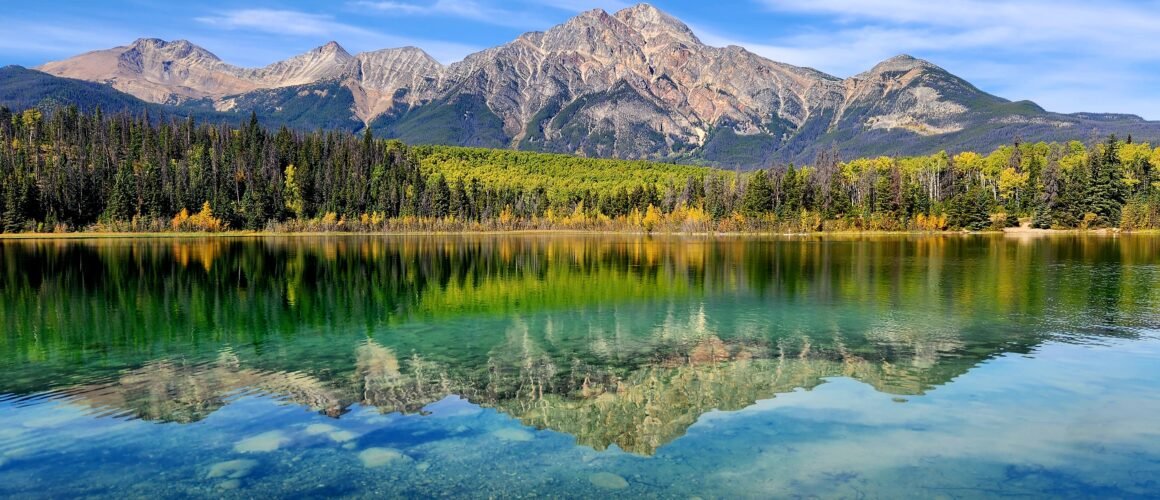
We pass in and out of cool forests of trembling aspen, lodgepole pine, and Douglas fir. Crickets buzz and snap alongside us in the bright sunshine. The trail first takes us past Patricia Lake before continuing on to Pyramid Lake, though Pyramid Mountain forms the panoramic backdrop to both lakes. The mountains and their colours reflect crisply in the waters, disturbed only by the occasional ripple from the wake of a gliding canoe.
It’s quiet up here and many people have clearly settled in for the long-haul on such a tremendously bright day. Couples push canoes and kayaks away from the tiny beach and paddle lazily across the lake; others position themselves on benches along the floating dock, keeping one beady eye on the prime real estate that is the iconic bright red Adirondack chairs. We watch the people watching the people and take in those 180-degree views, munching on our packed lunch of bananas and Cliff bars. The strong sun, in the end, is the catalyst for movement, and so we give up our pretty spot on the dock and start our slow meander back to town.
The Maligne Valley ‘Must-do’
We’re up early the next day to tackle a hike at Maligne Lake. The visitor guide that came with our National Parks entrance pass has warned us that ‘this is a high-traffic site with limited parking’ so we pretty much roll out of bed and start driving. I’ve made overnight oats so we can have breakfast as soon as we arrive at the lake, though I pray all the way up the winding 48km road that they survive the journey – we don’t have clingwrap and so the brimming bowl has the rest of the fridge items packed around it to keep it level on the shelf. (By this point, we’ve got previous where fridge mishaps are concerned; forgetting to secure the fridge door with the latch mechanism, we opened the camper door on one occasion to find a carpet of cherry tomatoes and blueberries on the floor of the van).
I need not have worried; the overnight oats are nearly frozen – much like my fingers at 1,690m above sea level as we discover the lake is. Having breakfast at a spot overlooking the lake is out of the question; we get into the back of the van and turn the heating up full blast, a cup of tea providing some welcome warmth to our hands through the thin plastic cups.
Once we’ve put on a few more layers, we emerge from the van and shoulder our packs. Though it’s only 8am there are already several busloads of tourists ambling about on the foreshore, waiting to board the first boat cruise of the day. The short cruise is the major drawcard for most tourists; Spirit Island, a small tree-covered peninsula tucked near the centre of the lake and surrounded by towering mountain peaks, is one of the most photographed and iconic vistas in all of Canada.
Maligne Lake itself is the largest natural, glacier-fed lake in the Canadian Rockies. Spanning approximately 22km in length, its intense azure-blue waters ringed by dramatic snow-capped peaks and glaciers, it is a truly striking location. The surrounding valley provides a multitude of hiking options from low elevation walks through subalpine forests, to the 44km Skyline Trail, one of the most celebrated multi-day backpacking routes in Jasper National Park. We opt for one of the longer day-hikes – the Bald Hills Trail – a steep climb that opens up into a sweeping panoramic vista over the lake and provides 360-degree views of the surrounding mountain ranges.
According to the visitors’ guide, bears and moose love the Maligne Valley. One of the low elevation trails the Bald Hills Trail intersects with is called Moose Lake Trail – so called because moose are often seen there. Additionally, at the start of the trail we’ve chosen, there are lots of signs saying that ‘bear encounters are likely’ – not just possible, likely – and we should specifically watch out for them grazing on berries along the edge of the trail. I’ve got the bear spray holster on my waist so I guess we’re as prepared as we can be.
The trail starts off broad under a canopy of trees, on terrain of well-packed earth. It’s not terribly steep at the outset but demanding enough that we’re already working up a bit of heat and we need to stop and strip off some layers. There are plenty of other hiking parties on the trail and they do the same; the day is warming up, and shafts of sunlight filter through the branches of pine and spruce.
A few kilometres along, and we’re presented with the ‘straight up’ or ‘gradual ascent’ option. Preferring a loop walk, we opt for the more demanding route so we can take the more gentle, easier-on-the-knees, path back down. The path becomes single-file and steep; the tree-roots underfoot creating more challenging terrain.
Eventually, the forest thins and dramatic views begin to open up as we climb. We can see the alpine loop that traverses a series of open, grassy round-topped hills, but we aim for the true summit first, standing at nearly 2,300m. When we get to the ridgeline the wind picks up, and by the time we reach the summit we are putting our layers back on. We find a well-sheltered spot on which to have our lunch whilst overlooking Maligne Lake, framed by the jagged limestone peaks of Mount Samson, Mount Warren, and other snow-capped mountains. The view is breathtaking.
At this point, we have our first wildlife encounter of the day – no bears, not moose, but a golden-mantled ground squirrel, who is on a mission to get some lunch. He gets inches away from my sandwich before he darts between the rocks, only to appear whack-a-mole style from some other hole. It’s entertaining and very cute, but he’s a persistent little devil; eventually I stand up to finish my lunch, and he moves on to another group.
After lunch, gone is the desire to walk the alpine loop; we figure out that it’s a more than 14km return walk and according to my watch, there’s been over 900m of ascent. This isn’t ‘as advertised’ in the National Park Visitor Guide which advises 600m of ascent and a 9-13km return, dependent on the route you take. As anyone in our road cycling group will tell you, I get a bit cranky when things get longer than planned and so I can’t bear adding even more distance by taking the gentler way down (by this point I’m mistrustful of anything I’ve read, and my risk-averse nature means the guiding principle swiftly becomes ‘go with what you know’).
My knees are complaining by the end of it, but I have no regrets. It is a marvellous walk, with views which are truly stupendous, and it’s a fitting way to end our time in Jasper.
We’ll take it easy on our drive down the Icefields Parkway…
Next Stop, Lake Louise