“Yeah, could you drop in at my place and take some elk outta the freezer because I want to make burgers and apparently nobody is answering the phone there…”.
The lad behind the counter at Wells Gray Outfitters is on his cell when we open the door but he raises his chin to acknowledge us. We mooch around the store; a warmly-lit log cabin jam-packed with the finest of mountain bike and outdoor gear.
“What can I do for you fine folks?” he asks when he finishes his call.
We tell him we’re here to buy bear spray. We haven’t seen it on the shelves of the stores, campground shops, or visitor centres but we’ve been pointed in his direction.
A Lesson on Bear Spray
There’s a good reason it’s not on the shelves: as it turns out, bear spray is more of a ‘behind-the-counter’ product because it’s classed as a weapon. On buying it, you supply your personal details and sign a waiver. The waiver is to protect both the retailer and the purchaser: if the purchaser ends up getting attacked by a bear anyway or injures themselves with the product, then the waiver indemnifies the retailer. And if the purchaser passes the bear spray onto someone else, they’re similarly indemnified. (Being a weapon, you can’t take it home on the plane with you, so you are likely to pass it on to someone. There are other alternatives such as surrendering it at a Police Station or to Parks Canada staff).
“You do not want to get this on yourself,” the retailer says. “Back when I worked for Parks [Canada], I got some on me one time and the pain is, like, basically the closest thing to getting shot.”
I raise my eyebrows sharply and make a face that I’m sure signals alarm and invites reassurance, for at this point I can’t help but think that I’ll end up doing more damage to myself than any approaching bear.
“Oh yeah,” he nods. “Why do you think the police use it?”
So no reassurances then; this stuff is vicious. He explains how and when to use it, specifically noting that we should aim slightly downwards because ‘even if you don’t think there’s wind, there’s always wind’ and, well, refer above.
Bears, bears everywhere…
I wasn’t all to bothered about the whole bear thing before I got here, but I’m now thinking that hiking the trails of Canada is fraught with danger. I suspect it’s the empath in me; soaking up the warnings from campsite staff and then reading every warning sign I see, advising on how to deal with a bear encounter. Posters are plastered everywhere: walls, trees, the back of toilet doors: ‘Be Bear Aware’ or ‘Keep a Bare Site’.
This means pack away all your food in your camper van or use the food storage lockers if you’re in a tent so bears don’t come round having sniffed out your burgers and bananas, and get rid of your rubbish in the bear-proof bins (I love these, there’s a little latch in a human hand-sized hole on the bin lid to open them). Bears can smell even the faintest scents from up to 1km away.
And when you’re on the trails, make lots of noise so you don’t surprise bears. At this time of year, they’re fattening up for hibernation and so it’s easy to disturb them when their face is deep in those luscious, low-lying forest berries.
There’s lots to remember where bear encounters are concerned: it’s a bit more than, ‘If it’s brown, lie down; if it’s black, fight back.’ How you should respond varies depending on what situation you’re in: the bear doesn’t see you, don’t get closer, back away and leave the area; the bear does see you, don’t make eye contact, talk calmly to let them know you’re human and back away; the bear starts to approach you, make yourself big, open your jacket, but be ready to use the bear spray; the bear is coming at you, use the bear spray when it’s about 10m away but know it’s only effective by the point at which the bear 5m away. Wait, what? I think ‘always carry clean undies’ is needing added to this advice.
We pay for the bear spray ($75CAD, though this includes a cute little holster with a picture of a bear on it – I’ll maybe keep that and repurpose it for something else…probably snacks) and thank the lad for his help. I brush away a large stink bug that has landed on the can.
“Oh yeah, you can always tell when someone has squished one of those,” the retailer says. “They smell like green apple. In fact, they taste like green apple as well. I ate one years ago, like, in high school where someone offered to buy my lunches for a week…”.
I tell him, “Buddy, you were born for this line of work,” and we leave the store with a wave.
Wells Gray: Spahats Creek Resort
The town of Clearwater (the location of Wells Gray Outfitters) is the main hub of, and gateway to, Wells Gray Park. The Park spans 1.3 million acres of alpine wilderness and contains 42 ‘official’ waterfalls, over 200 lakes, and over 250km of hiking and biking trails. It’s also home to the world’s only old-growth inland temperate rainforest and Canada’s largest alpine flower meadow. The meadow is on Trophy Mountain which, at the point of our arrival, has been closed temporarily by Parks Canada. This is alledgedly due to ‘a grizzly problem’.
Clearwater Valley Road runs from Clearwater town all the way to a dead-end at Clearwater Lake and Campground. It’s nearly 70km long, but after 40km it transitions from sealed road to gravel. We’re only 10km up the road to our campsite for the next few nights: Spahats Creek Resort, but on leaving the town the vast interior rainforest surrounds us immediately. The forest canopy lining the road is dominated by evergreen softwoods: Western Redcedar, with its wide, reddish-brown trunks and lace-like sprays of foliage; Western Hemlock, short needles on delicate branches; and Douglas Fir, distinctive for its deeply furrowed bark and distinct cones. Deciduous trees are intermingled: the bright white, peeling bark of Paper Birch, and the vibrant yellow foliage of Trembling Aspen, the colour only just having turned in these first few days of Autumn.
Our site at Spahats Creek Resort is amidst stands of these trees. With Andy still recovering (more vomiting ensues later in the day) we hunker down for another quiet night. But the campfire roars as it eats the logs and industrious squirrels chitter as they rain twigs and cones down onto the van roof and soft-needled forest floor. The last light of day crowns a nearby aspen gold under a pale blue sky, and the stars gradually appear. Trophy Mountain looms large in the dark when we retire to bed.
Chasing Waterfalls
The next day, Andy is feeling better. We plot out the waterfalls we’ll hit up and where we can do a short hike, nothing too strenuous. Given the ‘wallowy and boat-like suspension’ (Andy’s words) of the campervan, we decide to give the unsealed road a miss. Our plan is to go to the last waterfall at the end of the sealed road, hike the trail there, and work our way back along, stopping off at as many waterfalls as we have time for.
We start at Helmcken Falls, and it’s a beauty. The mighty Murtle River starts at a glacier in the Cariboo Mountains, flowing into Murtle Lake, then out again over seven waterfalls, including Helmcken. Plunging 141m into the canyon below, this is the fourth highest waterfall in Canada. It’s a spectacular and noisy site – both due to the gushing falls and the many, many tourists who are suddenly right there. This is strong encouragement for us to get to our planned hike on the other side of the canyon: the Helmcken South Rim Trail.
But we’re about to leave and a sign catches my eye: the Gatling Gorge Trail, 8km return. I suggest we do this instead, so we strap on the backpacks and head out. Interestingly, there are no stressy ‘bear aware’ signs here, but there is one that warns of a fungal infection spreading in bats which asks tourists to ensure they clean their gear before entering caves. People, who is doing this? In a country of bears, who is mooching into caves of their own free will?
The Gatling Gorge Trail is special. Another sign at the trailhead had warned of ‘no barriers’ and ‘steep drop-offs’ and boy did they mean that! The trail follows a cliff-edge along a canyon; from the path you could probably roll 10m down a slope and then there’s nothing but fresh air between you and the Murtle River, 130m below. This does mean panoramic views of the forest and the river as you meander along.
The trail is easy-going for the first 2km; there’s a viewpoint over the confluence of the Murtle and Clearwater Rivers. It then descends quite steeply over a more rooted and rock-strewn path. We hurdle fallen trees as we descend to the river.
Sunlight warms the wide, flat boulders next to the river, where we stop for lunch. White water thunders through a narrow passage of the canyon and it’s obvious why Wells Gray is a popular rafting location too. We see only one couple with their dogs down here, and very few people on the trail. It’s blissful, and we could lounge here longer, but it’s woken us up from the lethargy of the last few days too and we’re keen to get going to see more.
The hike ends up taking us 15 mins shy of 3 hours, and we’re glad that the other stops are just short walks to viewpoints. Dawson Falls is but a 5-minute drive along the road and it’s less than 10 mins to get from the car park to the viewpoint. These falls are only 20m high but they’re 90m wide and they tumble spectacularly over 200,000-year-old lava terraces.
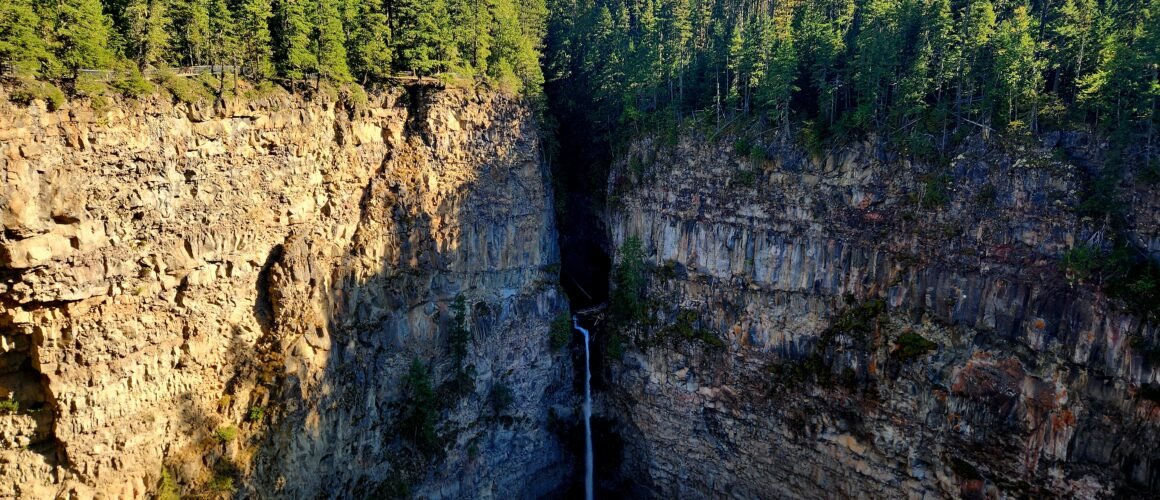
We then drive on to our final waterfall of the day, Spahats, only 1km down the road from our campsite. They are repaving the car park (I’ve concluded that there’s a lot of construction and roadworks that goes on in Canada immediately after summer, and before winter hits) so we have to walk a little bit to get there. It takes us by a viewpoint to The Shaden, a 45-metre cavern formed by water seeping between layers of ancient lava and eroding the rocks. (Maybe that’s where them bats are hanging out). We also catch a glimpse of snow-capped Garnet Peak (2,876m) in the distance.
Though smaller than Helmcken at 73m high, it’s worth the walk to see the thin stripe of Spahats plunge from a keyhole in the rock into a wide canyon below. The scale takes a minute to get our heads around; the trees surrounding the canyon rim are as high as two-storey houses and the canyon is a vast space. It’s more than a little dizzying following the line of white water that threads its way along the valley floor.
It’s a good end to the day. We’ve only scratched the surface of Wells Gray but I think we’ve got a sense of the place. The Park bills itself as ‘the Canada you imagined’; with its vast valleys, thunderous falls, and sprawling alpine wilderness, it kinda is.
Wells Gray: The Verdict
There’s so much to do here. I’d suggest 3 nights as a minimum, perhaps moving up the valley to a second campsite to get onto the unsealed road and into the wilderness near Lake Clearwater itself. And to get in a rafting trip somewhere as well, if that’s the sort of thing you like. For us, I noticed at the visitor centre that there’s a company offering guided hut-to-hut hikes from 3 to 7 nights which is something I’d come back for. It’s not a place of summits, but the forests are pristine, and the waterfalls unrivalled. I’d love to see more.
As for the campsite, Spahats Creek Resort is excellent. I’m assuming it was the owner who checked us in as she’s super-invested. She’s everywhere all the time, checking people in, keeping the washrooms clean, and stocking up the weekend ‘honesty’ bread and pastry stall. There are laundry facilities here too which is a campsite rarity, we’ve found.
And despite the site being under the shadow of Trophy Mountain, the bear count so far is zero.
Next stop, Mt Robson…